
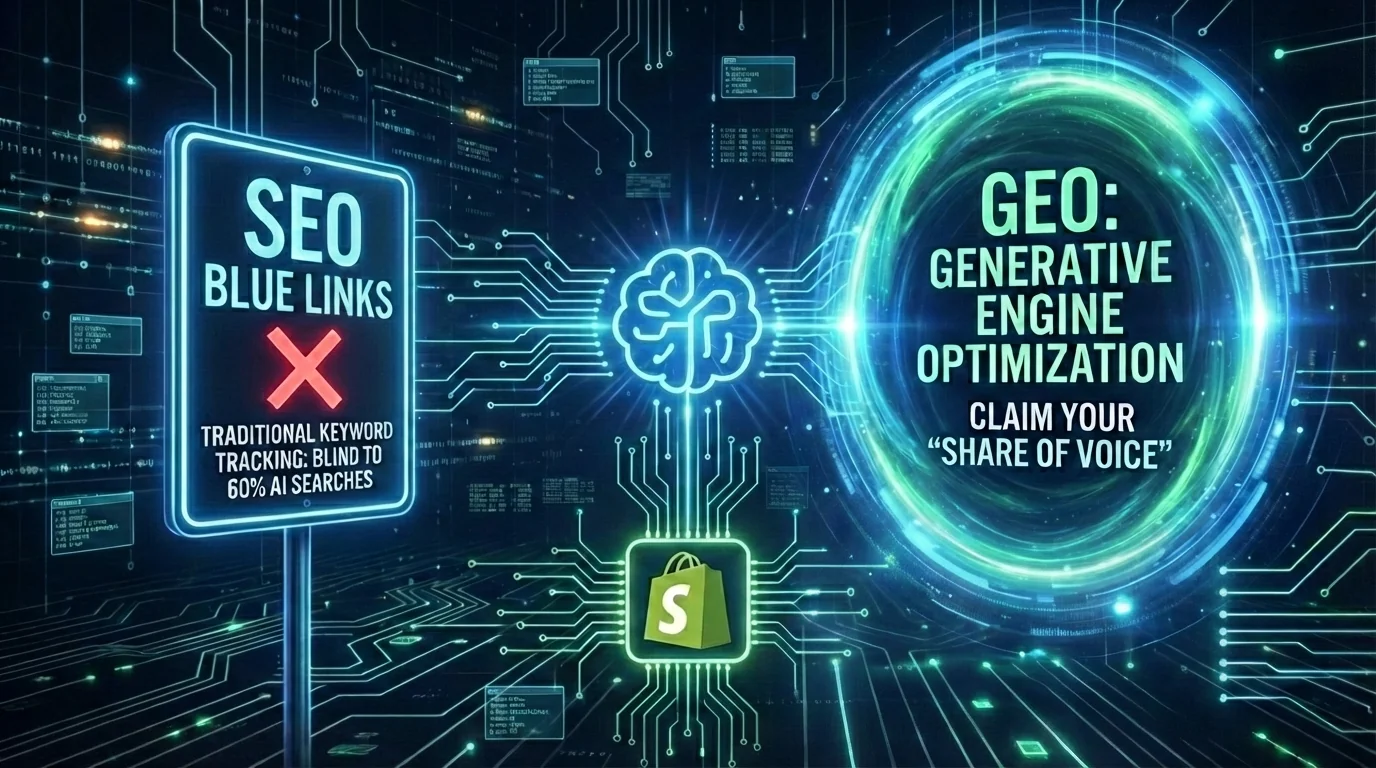
Traditional keyword tracking is blind to a rapidly growing share of searches that now end in AI‑generated answers, rather than clicks on classic ‘blue links’. This article explores the shift from SEO to GEO (Generative Engine Optimization) and reviews the elite toolkit - from the technical depth of Rankscale to the enterprise power of Profound - that Shopify merchants need to claim their "Share of Voice" in the age of LLMs.
The Great Re-Routing of Traffic
From our vantage point as a Shopify agency, 2026 marks the most radical shift in digital storefronts since the smartphone era, because AI assistants are starting to mediate discovery - not just search rankings. As a Shopify Expert Agency, we’ve watched the traditional "Blue Link" economy - the world of ranking #1 on a Google search results page - evolve into something far more complex: The Recommendation Economy.
The metrics we lived by for a decade—click-through rates (CTR) and keyword rankings—are no longer the full story. Today, your customers aren't just "searching"; they are conversing. They are asking ChatGPT for the "best sustainable running shoes for a marathon," querying Perplexity to compare your brand's return policy against a competitor's, and using Google’s AI Mode to build entire shopping carts without ever clicking a traditional organic link.
The New North Star: Share of Model (SoM)
For Shopify merchants, this shift is creating a new ‘zero‑click’ reality where more buying journeys start - and sometimes end - inside AI assistants, reducing the number of traditional organic clicks along the way. If your products are not being cited by these LLMs (Large Language Models), your brand essentially ceases to exist in the fastest-growing traffic channel of the decade.
Visibility in 2026 is no longer about being at the top of a page; it’s about being integrated into the answer. This falls under Generative Engine Optimization (GEO)—the emerging practice of optimizing content for visibility and citations inside AI‑generated answers across tools like ChatGPT, Perplexity, and Google’s AI experiences. To win, you need to look beyond traditional SEO and start measuring your brand’s ‘Share of Model’—how often, how favorably, and how accurately AI agents recommend your store versus competitors.
Why Measurement is the Only Way Forward
You cannot optimize what you cannot see. Because AI responses are generative and personalized, they are a "black box" compared to the static search results of the past. As an agency, our primary goal is to turn this black box into a transparent dashboard.
Whether you are a Shopify Plus enterprise or a scaling mid-market brand, understanding which tools actually track these conversational mentions is the difference between leading your niche and being left behind by the algorithms. In this article, we evaluate the elite tier of 2026’s AI-native visibility tools and see how they stack up against the legacy SEO giants who are fighting to stay relevant.
The 2026 Landscape of "GEO" Tools
The measurement of AI visibility is no longer a niche experimental field. By 2026, AI visibility has evolved from an experiment into a fast‑maturing ecosystem, with both specialist GEO platforms and legacy SEO suites racing to add answer‑engine tracking. As your Shopify store's traffic begins to shift from the classic "ten blue links" to conversational responses, the tools used to measure success have split into two distinct factions: the Agile Specialists (built for AI from day one) and the Legacy Powerhouses (classic SEO tools that have successfully integrated AI tracking).
The New Architecture of Search Measurement
In the past, a crawler only needed to see what was on your page. Today, these tools must simulate complex human prompts across multiple LLMs—including ChatGPT (OpenAI), Claude (Anthropic), Gemini (Google), and Perplexity—to see if your products are being recommended and, more importantly, why.
The Specialists: Built for the "Answer Engine" Era
These players were born in the post-GPT explosion. They don’t just track keywords; they track sentiments, citations, and agentic behavior.
- Profound (New York): An enterprise‑grade platform for AI shopping visibility. Profound has emerged as one of the leading options for understanding which signals correlate with your products appearing in AI shopping experiences.
- Bluefish AI (Phoenix): Focused on brand protection and influence - monitoring AI answers for hallucinated claims or reputation risk, and giving premium brands workflows to correct and shape how assistants talk about their products.
- Scrunch AI (London): Positions itself as an Agent Experience Platform (AXP). It focuses on how AI agents and answer engines consume your content, maintaining an AI‑optimized version of your site so that non‑human visitors can reliably crawl, interpret, and cite your offers.
- AthenaHQ (San Francisco): Markets itself as an intelligence hub for AI visibility, aggregating brand mentions across answer engines and recommending which content and data gaps to close first.
- Peec.ai (Berlin): Known for its high-velocity UX, Peec.ai has quickly become a favorite for scaling Shopify brands in Europe. It excels at "Prompt-to-Purchase" attribution, showing which AI chats actually led to store sessions.
- Rankscale (Königstetten): The technical pioneer. While others focus on high-level dashboards, Rankscale provides the most granular data on technical GEO (Generative Engine Optimization) at a price point accessible to mid-market merchants.
The Legacy Adaptors: Bringing AI into the Dashboard
For agencies already deep in the Semrush or Ahrefs ecosystems, the transition has been made easier by dedicated modules that sit alongside traditional SEO data.
- Semrush (AI SEO Toolkit): Their 2026 update allows Shopify owners to track "Share of Voice" across AI Overviews (AIO) and traditional search in a single view.
- Ahrefs (Brand Radar): Leverages their massive backlink index to see which third-party articles are being used as "Knowledge Sources" by LLMs to recommend your store.
| Tool Category | Best For | Complexity | Shopify Effort |
|---|---|---|---|
| Enterprise Specialists (Profound, AthenaHQ) | Shopify Plus / Global Brands | High | High (API/Dev required) |
| Growth Specialists (Peec.ai, Rankscale) | Mid-Market Shopify Stores | Medium | Low (Dashboard-ready) |
| Legacy Adaptors (Semrush, Ahrefs) | Existing SEO Workflows | Low | Instant (No new setup) |
Key Players & Shopify Suitability
In this era of Generative Engine Optimization (GEO), choosing the right measurement partner is the most critical decision a Shopify merchant will make in 2026. Here is the definitive breakdown of the key players—both the AI-native disruptors and the legacy giants.
1. The Enterprise Powerhouse: Profound
Profound has established itself as the "Bloomberg Terminal" of AI visibility. Its strength lies in deep, multi-layered data that spans from high-level brand sentiment to granular server logs.
- Key Features: Their "Shopping Visibility" module is a game-changer for Shopify; it specifically tracks how products appear in the carousel tiles of ChatGPT and Google’s AI Mode.
- Shopify Suitability: High for Shopify Plus users. Its "Agent Analytics" helps developers see exactly how AI bots crawl their store, allowing for technical optimizations of the liquid code.
- Ideal For: Large-scale merchants who need to justify AI-spend through massive data sets and competitive "Share of Model" metrics.
2. The Technical Pioneer: Rankscale
Rankscale has democratized GEO by offering the most technical "rank tracking" for AI at a price point that makes sense for mid-market brands.
- Key Features: Unique "Query Fan Out" tracking, which tests how your store is recommended across different model versions (e.g., GPT-4o vs. GPT-5). They provide an "AI Readiness Score" that audits your store's schema and content structure.
- Shopify Suitability: Excellent. It is arguably the most actionable tool for a standard Shopify store owner who wants to know exactly which product descriptions to rewrite to trigger an AI citation.
- Ideal For: Agencies and technical founders who want a "hands-on" tool to move the needle daily.
3. The UX Leader: Peec.ai
Peec.ai has won over the European market with its focus on "Prompt-to-Purchase" attribution. It moves past simple mentions to show what actually drives traffic.
- Key Features: Known for its clean, intuitive dashboard and Looker Studio integration. It provides a "Sentiment Score" (0–100) that alerts you if an AI starts associating your brand with negative terms like "shipping delays" or "poor quality."
- Shopify Suitability: High. Its focus on revenue attribution makes it easy to see the ROI of your optimization efforts directly in your analytics.
- Ideal For: Growing D2C brands that value a beautiful, readable interface over complex raw data.
4. The ROI Strategist: AthenaHQ
AthenaHQ is less of a "tracker" and more of a "strategic consultant" in software form. It is built for brands that want to dominate the conversational landscape through aggressive content "sniping."
- Key Features: The "Action Center" identifies content gaps—queries where your competitors are being cited but you are not—and provides briefs to help you "snipe" those citations.
- Shopify Suitability: Moderate/High. It requires a solid content strategy to be effective. For Shopify stores with active blogs, it is an invaluable growth engine.
- Ideal For: High-budget brands focused on aggressive market share acquisition.
5. The Reputation Defender: Bluefish AI
Bluefish treats AI visibility as a matter of brand safety and accuracy. In 2026, AI "hallucinations" (where an AI lies about your prices or stock) are a major risk for Shopify stores.
- Key Features: "Brand Data Verification" allows you to report inaccuracies directly to AI providers and tracks whether those models are "learning" the correct facts about your products.
- Shopify Suitability: Essential for high-profile brands or stores in sensitive niches (Health, Luxury, Finance).
- Ideal For: Brands where reputation and factual accuracy are non-negotiable.
6. The Crawler Specialist: Scrunch AI
Scrunch calls itself an "Agent Experience Platform" (AXP). It focuses on the bridge between your site’s code and the AI bot’s "brain."
- Key Features: It provides a real-time feed of which bots (OpenAI, Perplexity, etc.) are visiting your Shopify store and which specific pages they are "scraping."
- Shopify Suitability: High for technical SEOs. It helps ensure that your store’s JavaScript-heavy elements aren’t blocking AI bots from reading your product data.
- Ideal For: Developer-led teams and tech-heavy Shopify agencies.
For brands already heavily invested in their current tech stack, the two giants of the SEO world have evolved rapidly. By 2026, they have moved beyond traditional backlinks to offer sophisticated AI-specific monitoring that sits right alongside your organic traffic data.
7. The All-in-One Powerhouse: Semrush
Semrush has integrated AI visibility as a core pillar of its platform, treating LLM prompts with the same scientific rigor it once applied to keywords.
- Key Features: Includes an "AI Visibility Score" that benchmarks your brand's presence in AI-generated answers against a median of industry competitors. It offers specialized "Prompt Research" to find high-volume topics users ask AI, and an "AI Search Site Audit" to flag technical blockers that prevent bots from crawling your Shopify store.
- Shopify Suitability: High for existing users. It bridges the gap between traditional search and AI, showing which pages earn both backlinks and AI citations in a single unified dashboard.
- Ideal For: Marketing teams and agencies that want to manage SEO, PPC, and AI visibility under one roof without learning a new interface.
8. The Authority Specialist: Ahrefs
Ahrefs has taken a "Big Data" approach with Brand Radar, leveraging a massive database of over 100 million search-backed prompts to show how brands are framed across the conversational web.
- Key Features: Primarily focuses on "AI Share of Voice," discovering what percentage of AI chats actually mention your brand compared to rivals. Its "Citation Identification" distinguishes between simple mentions and high-value clickable links back to your store.
- Shopify Suitability: Excellent for "Entity SEO." It helps technical Shopify teams understand how their backlink profile directly influences their authority within AI knowledge graphs.
- Ideal For: Technical SEOs and authority-focused brands that need to monitor competitive moves across massive datasets of real (non-synthetic) AI interactions.
Players Compared: Suitability for Shopify
| Tool | Monthly Cost (Starting) | Main Focus | Shopify Integration | Ease of Use |
|---|---|---|---|---|
| Rankscale | €20 | AI Rank Tracking | Manual/Actionable | High |
| Peec.ai | €89 | Revenue Attribution | Looker Studio | Very High |
| AthenaHQ | $295+ | Content Strategy | Action Center | Medium |
| Scrunch AI | $100+ | Bot/Crawler UX | GA Integration | Medium |
| Profound | $300+ | Enterprise Data | API / Shopping Feed | Low (Technical) |
| Semrush | $99/mo per domain for Add‑on to base Pro ($139.95/mo) | Sentiment & Perception | AI-Ready Site Audits | High |
| Ahrefs | Lite: $99/mo; Standard: $199/mo | Real Search Prompts | Backlink/Citation Sync | Medium |
Your AI Roadmap for 2026
The shift from "Search" to "Answers" is the most significant change to the Shopify ecosystem in a generation. For our agency, the recommendation is clear:
- If you are a scaling brand looking for quick wins, start with Rankscale or Peec.ai. They offer the best balance of cost and actionable insight.
- If you are a Shopify Plus enterprise, you cannot afford to ignore Profound or Bluefish AI; the risk of hallucinations and the need for shopping carousel visibility are too high to leave to chance.
The "Blue Link" era is fading. In 2026, your Shopify store's success is measured by the quality of the conversation an AI has about you behind closed doors.